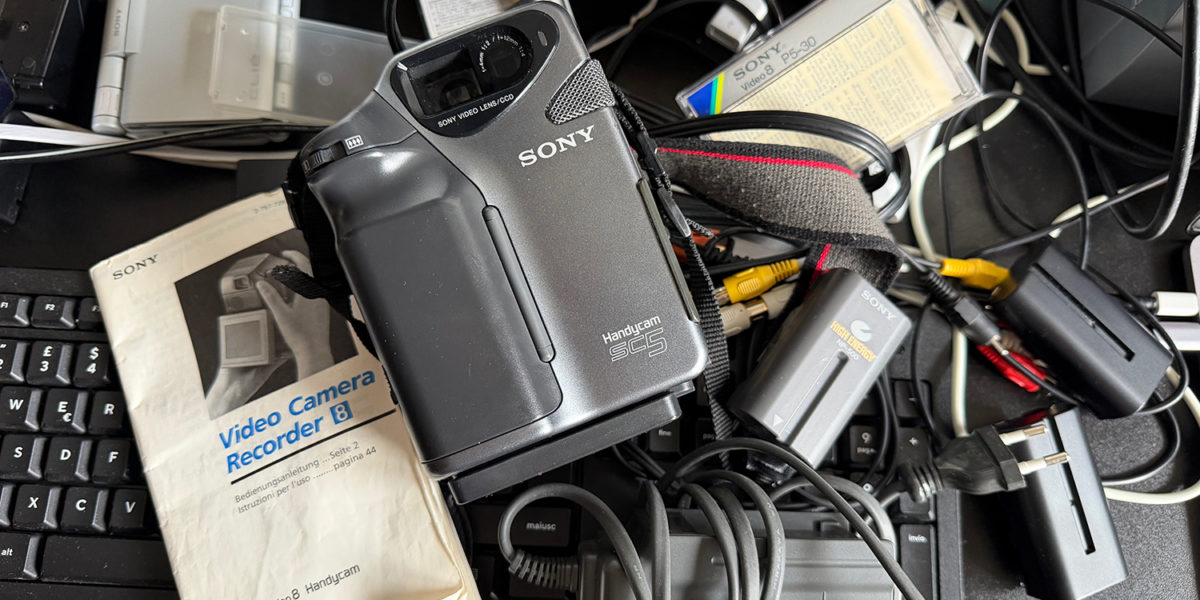
The Sony CCD-SC5E is the kind of camcorder you pick up at a flea market, turn over in your hands, and think — this feels like it was built to last. No creaky plastic, no wobbly hinges, no hollow rattle when you shake it. Just a dense, compact slab of early-90s Sony engineering with a fold-out LCD screen and a lens that says “Sony Video Lens” in simple white lettering.
I’ve owned one for a while now, and mine looks practically new. The gray body has barely a scuff on it, the tape mechanism clicks with confidence, and the screen folds out as smoothly as the day it left the factory in Japan. It’s the kind of condition that makes you wonder if the original owner bought it, filmed one vacation, and then put it in a drawer for thirty years.
Which, honestly, is probably exactly what happened with most of these.
The Sony CCD-SC5E is a Video8 Handycam from the early-to-mid 1990s — part of Sony’s massive consumer camcorder lineup during the decade when practically every family owned or wanted a camcorder. It wasn’t the flagship. It wasn’t the budget basement model either. It sat in a comfortable middle ground: affordable enough for a normal household, capable enough to produce genuinely watchable home video, and small enough to throw into a bag and forget about until something worth recording happened.
In 2026, it’s a time capsule. And a surprisingly useful one, if you know what you’re doing with it.
Table of Contents
The Era: Sony and the Video8 Boom
You can’t really talk about the Sony CCD-SC5E without talking about the era it came from. The early-to-mid 1990s were the absolute peak of the consumer camcorder market. Video cameras had shrunk from shoulder-mounted bricks to palm-sized devices, tape formats had stabilized, and prices had dropped to the point where a camcorder was a realistic purchase for a middle-class family — not a luxury item.
Sony was the undisputed king of this space. Their Handycam brand had become synonymous with “camcorder” in the same way that Xerox meant “photocopier” or Jacuzzi meant “hot tub.” By the early 90s, Sony offered a dizzying range of models: Video8 for the budget-conscious, Hi8 for those who wanted better quality, and later Digital8 for the digital transition. Every price point was covered, every use case addressed.
The CCD-SC5E landed in the 1993-1995 window — solidly in the Video8 tier. By this point, Hi8 was already available and offered notably better resolution (400 lines versus Video8’s 240). So why was Sony still making Video8 cameras? Because not everyone needed or wanted to pay for Hi8. The SC5E was for families who wanted to record their kids’ birthday parties, holidays, and school plays without spending more than necessary. It did exactly that job, and it did it well.
For a deeper look at where Video8 sits in the format hierarchy, check out our Hi8 vs Video8 vs Digital8 comparison.
Design and Build: Made in Japan, Built to Last
The first thing that strikes you about holding a Sony CCD-SC5E is the build quality. This was manufactured in Japan, back when Sony still assembled most of their consumer electronics domestically. And you can feel it.
The body is compact — roughly 10.5 cm wide, 14 cm tall, and 8 cm deep, weighing about 800 grams without the battery. It’s a true palmcorder design, shaped to be gripped and operated with one hand. The right side has a contoured grip area with a wrist strap, and your index finger naturally falls on the record button mounted on top.
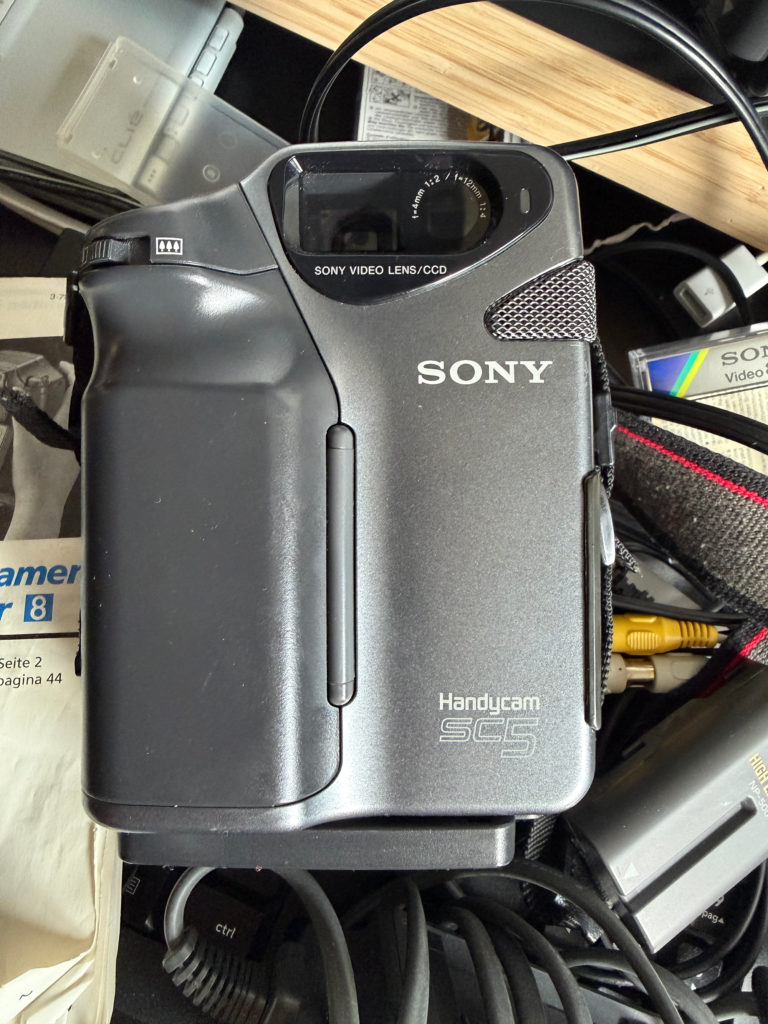
The dark gray plastic has a slightly matte, almost soft-touch quality to it. There’s none of that cheap, shiny plastic that plagued later budget camcorders. Every seam is tight. Every button press has a firm, deliberate click. The cassette compartment — accessed by unlatching a large section of the rear panel — swings open with a mechanical precision that’s almost theatrical. You drop in a Video8 cassette, push it down, the mechanism pulls it in, and the door closes with a satisfying click. It’s one of those small engineering details that you don’t notice until you’ve used a camcorder where the tape door feels like it might snap off at any moment.
The fold-out LCD screen on the back of Sony CCD-SC5E is a 3-inch TFT active matrix panel. In the early 90s, having an LCD screen on a camcorder at this price point was a genuine premium feature — many competitors still only offered a small black-and-white electronic viewfinder. The SC5E has both: the fold-out color LCD for general use, and a smaller black-and-white electronic viewfinder for when you want to save battery or shoot in bright sunlight where the LCD washes out.
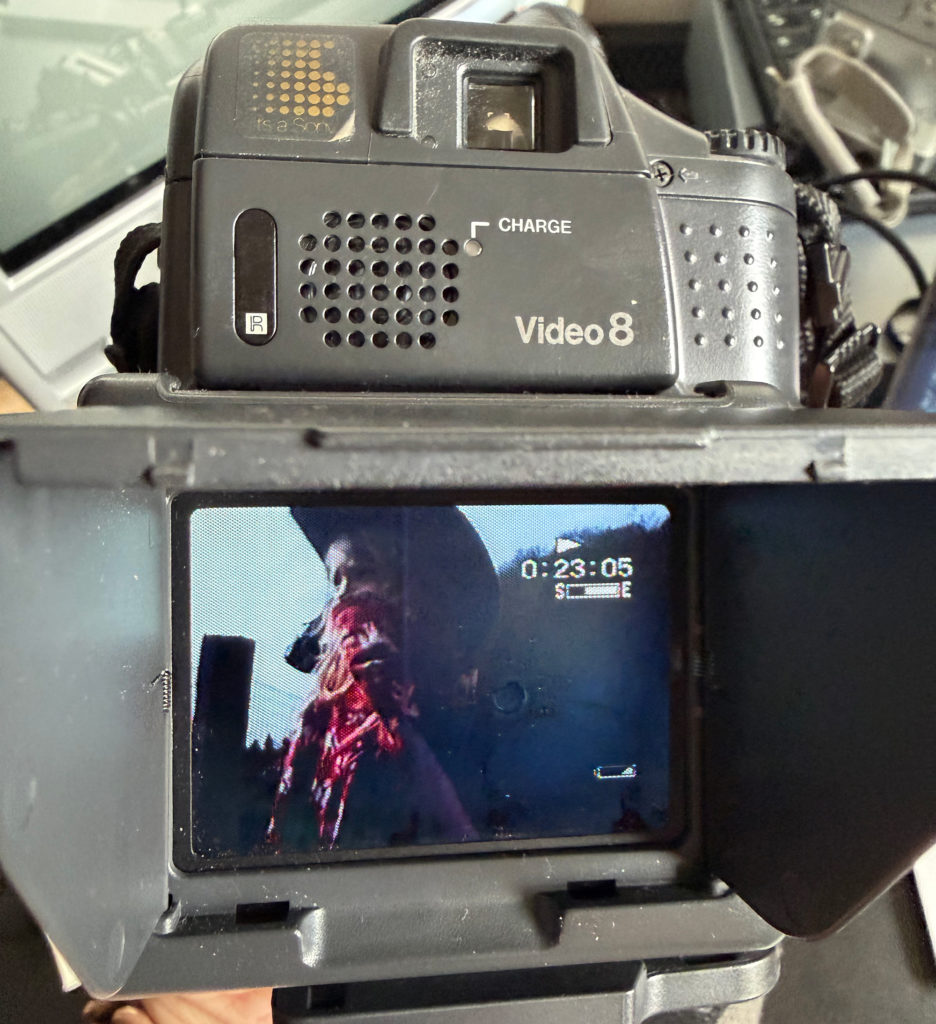
The screen’s hinge is surprisingly robust. Mine still opens and closes with smooth resistance after three decades. Sony clearly overengineered this component, and it paid off in longevity.
Beneath the LCD you’ll find a row of small but well-labeled buttons for date/time adjustment, display toggle, and a review function that plays back the last few seconds of your recording. On the left side, behind a hinged door, sit the playback transport controls — play, rewind, fast forward, stop. These are the controls you use when watching back footage on the LCD screen or when outputting to a TV.
The bottom of the camera has a tripod thread, a small fold-out kickstand for tabletop use, and a few DIP switches for beep volume, remote control mode, and the record button behavior (momentary press vs. toggle). The kickstand is a nice touch — set the camera on a table, flip the LCD around to face the front, hit record from the remote, and you’ve got a self-filming setup. Surprisingly forward-thinking for the early 90s.
The Sony Video Lens
Let’s talk about the lens — and let’s be clear about what it is, because there’s some confusion online. The Sony CCD-SC5E does not have a Carl Zeiss lens. It uses a Sony Video Lens with the following specifications:
f=4-12mm, f/2 to f/4
That’s a 3x optical zoom range. In 35mm equivalent terms, you’re looking at something in the neighborhood of 40-120mm — a moderate telephoto starting point with a useful but not extreme zoom reach.
The f/2 maximum aperture at the wide end is decent for indoor shooting, though by the time you zoom in to the telephoto end, the aperture narrows to f/4, which means the camera needs more light when zoomed in. This is a common trade-off in zoom lenses of this era and price class.
Three-times optical zoom sounds modest, and plenty of competitors were already advertising 8x, 10x, or even 12x zoom ratios. But there’s a reason some experienced videographers actually prefer short zoom ranges: fewer optical elements mean fewer aberrations, less flare, and generally sharper images across the zoom range. The Sony Video Lens on the SC5E is not a complex optic — it doesn’t need to be. It’s a simple, well-corrected zoom that produces a clean, pleasantly warm image.
One thing I noticed: the zoom motor on the SC5E is relatively quiet compared to later Handycam models. It’s not silent — you can hear a faint whir if you’re recording in a very quiet room — but it’s well-dampened. The zoom action is smooth, with no jerkiness or sudden speed changes. You can do a slow, cinematic zoom-in without it lurching.
The camera also features a dual-position focus switch on the front panel — one position for subjects at normal distance (130cm and beyond) and another for close-up work (from 35cm). This isn’t a true macro mode, but it’s useful for recording documents, drawings, or small objects at close range without the autofocus hunting endlessly.
The CCD Sensor and Image Quality
The heart of the Sony CCD-SC5E is its CCD image sensor — a true charge-coupled device, the technology that defined analog camcorder imaging for over two decades.
CCD sensors have a character that’s fundamentally different from the CMOS sensors used in modern cameras. The way a CCD reads light produces smooth, organic tonal transitions. Highlights don’t clip abruptly — they bloom gently. Colors have a saturation that feels rich but natural, with warm skin tones and deep, velvety shadows. There’s a softness to the image that isn’t a flaw — it’s a characteristic. It’s the reason why footage from these cameras has an emotional quality that modern 4K video somehow doesn’t.
At 240 lines of horizontal resolution, the CCD-SC5E delivers standard Video8 quality. Let’s be honest about what that means: this is not a sharp image by any modern standard. Fine detail is limited. Text is only legible at close range. Fast motion produces smear. But here’s what 240 lines is good at: capturing moments. Faces, gestures, movement, atmosphere — the things that actually matter in home video. You always know who’s in the frame and what’s happening. And the analog CCD rendering gives those moments a warmth and texture that people respond to emotionally in a way they don’t with clinical digital footage.
This is exactly why vintage CCD camcorders have become so popular with creative filmmakers and content creators in recent years. The “CCD look” — warm colors, gentle highlights, organic grain — has become a deliberate aesthetic choice. People are buying old Handycams on eBay specifically for the way they render images. The Sony CCD-SC5E won’t give you the best CCD image in Sony’s lineup (the Hi8 models with their higher resolution and S-Video output are better for that), but it absolutely delivers that characteristic CCD warmth and personality.
Here will be some actual footage from my Sony CCD-SC5E to show you what this camera produces, stay tuned! ?
As you can see, the image has that unmistakable analog character — soft, warm, slightly dreamy. The colors are rich without being cartoonish, and the way light falls off in the highlights is something digital cameras still struggle to replicate naturally.
Recording Format: Video8 Explained
The Sony CCD-SC5E records on standard Video8 cassettes — the original 8mm analog format introduced by Sony in 1985. These are compact tapes measuring 95 × 62.5 × 15mm, significantly smaller than VHS cassettes, which is what allowed camcorders like this one to be so portable.
Recording times depend on the mode: SP (Standard Play) gives you up to 90 minutes on a standard PAL cassette (or 120 minutes for NTSC), while LP (Long Play) doubles that but at reduced quality. Always record and play back in SP if you have the choice — LP recordings are more prone to tracking errors and dropouts, especially as tapes age.
Video8 records an analog FM video signal and analog audio onto the magnetic tape. The audio is monaural (mono) on the Sony SC5E — no stereo. The recording is purely analog, which means there’s no digital timecode, no metadata, and no way to do frame-accurate editing from the tape. What you record is what you get, warts and all.
The cassettes are physically identical to Hi8 tapes — you can use Hi8-branded tapes in the SC5E and they’ll work fine, though the camera will record standard Video8 quality regardless of the tape grade. For more on the differences between these formats, see our full format comparison guide.
Audio: Mono, But Honest
The Sony CCD-SC5E records mono audio through its built-in electrostatic microphone, mounted behind a small metal grille on the front face of the camera. It’s omnidirectional, picking up sound from all directions — including, inevitably, the noise of the tape transport and your own breathing if you’re holding the camera close.
Audio quality is what you’d expect from a consumer camcorder mic in the early 90s. Voices are intelligible at conversation distance. Music is recognizable but lacks bass and treble definition. Background noise is always present — the hiss floor is noticeable on quiet recordings.
There’s a microphone input jack on the left side panel, which is a genuinely useful feature if you want better audio. Plugging in even a cheap external mic makes a dramatic difference compared to the built-in unit. For interview-style recordings or any situation where audio clarity matters, the external mic jack is a lifesaver.
There’s also a mono earphone jack for monitoring playback audio, and a small built-in speaker with a volume control wheel for reviewing recordings without headphones.
Usability: Designed for Real People
Sony designed the Sony CCD-SC5E for people who didn’t read manuals, and it shows — in the best possible way.
The main power switch has three positions: OFF, CAMERA, and VCR (playback). Slide it to CAMERA and you’re ready to record. Slide it to VCR and you can watch what’s on the tape. That’s it. The big red START/STOP button is where your finger naturally rests when gripping the camera. Press once to start recording, press again to stop. Zoom in and out with the rocker switch under your index finger.
That simplicity is the Sony SC5E’s greatest strength as a consumer product. Your grandmother could use this camera. Your ten-year-old could use this camera. There’s nothing to configure, nothing to accidentally break in a menu system, no settings to lose. It just works.
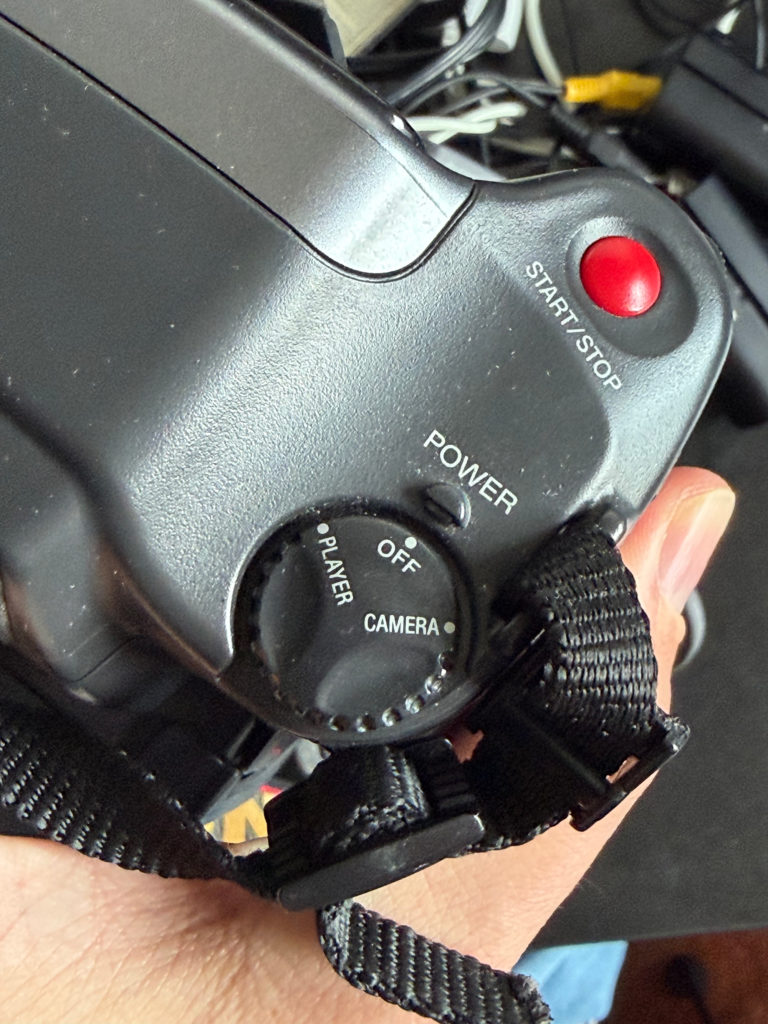
The auto exposure system is fully automatic — there’s no aperture priority, shutter priority, or manual mode on this camera. You point, you shoot, the camera handles the rest. In well-lit daytime and indoor situations, it does a perfectly decent job. In challenging lighting — strong backlighting, mixed sources, very dim rooms — it can be fooled, but that’s true of every auto-only camcorder from this era. The lack of manual exposure control is consistent with the Sony SC5E’s positioning as a simple, family-oriented Video8 camera. Sony reserved those features for their higher-end Hi8 models.
Connectivity and Digitization
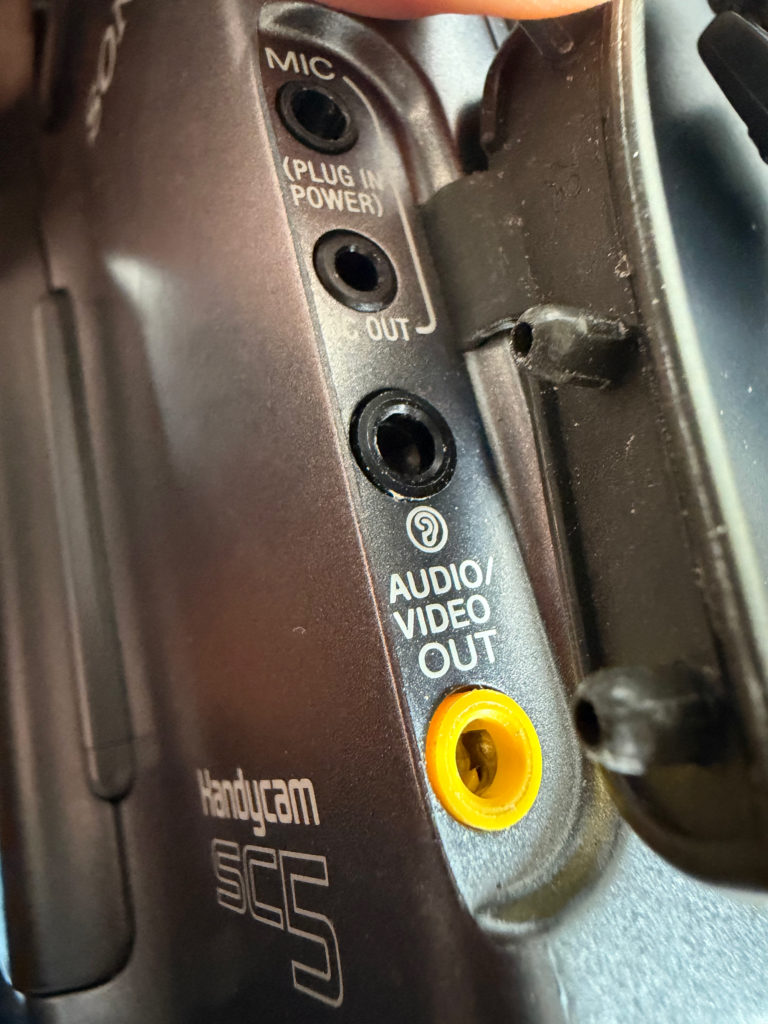
The Sony CCD-SC5E has the following connections:
- Composite video output (RCA yellow jack)
- Audio output (RCA white jack)
- Microphone input jack
- Earphone jack (mono)
- DC output jack
- 20-pin multi-terminal port (bottom, for Sony accessories)
Notably absent: there’s no S-Video output (that was reserved for Hi8 and above) and no FireWire port (this is analog, not DV). All video output goes through the composite connection.
For digitizing your Sony CCD-SC5E tapes, the process is straightforward: connect the camera’s composite and audio outputs to a USB capture device (EasyCap, Elgato Video Capture, AverMedia, or similar), plug that into your PC, and use capture software to record the playback.
The capture timer feature is handy for unattended recordings — set it to 90 or 120 minutes and walk away, and the software stops automatically.
You can try it free for 7 days to verify it works with your setup before buying.
For a complete walkthrough of the analog capture process, see our guide to digitizing VHS tapes — the process for Video8 is identical, just with the camcorder as your playback source instead of a VCR.
Reliability and Common Issues in 2026
If you’re looking to buy a Sony CCD-SC5E today — for tape playback, digitization, or vintage filming — here’s what to watch for:
Capacitor aging. The electrolytic capacitors in 90s electronics have a finite lifespan. After 30+ years, some may have dried out, causing power instability, display issues, or audio distortion. There’s no way to know without testing the unit. If a seller says “powers on, untested otherwise,” proceed with caution.
Tape transport wear. The rubber components in the tape path — pinch rollers, idler tires, belts — degrade with age regardless of use. Hardened or sticky rubber can cause tape jams, uneven playback speed, or tracking errors. If you hear squealing during playback or the tape doesn’t wind smoothly, the rubber components likely need replacement.
Battery situation. Original NP-500 and NP-F530 batteries are long dead by now, but the good news is that the NP-F mount became the most widely used battery mount in the video industry. Third-party NP-F550/F750/F970 batteries are cheap, plentiful, and compatible. The AC-V505 power adapter also works to run the camera from mains power, bypassing the battery entirely.
LCD screen. The TFT panel can develop dead pixels, discoloration, or backlight failure over time. The screen on mine is still perfect, but this varies unit to unit. The camera still works fine through the electronic viewfinder if the LCD dies, so it’s not a total dealbreaker.
Head clogging. If the camera has been sitting unused for decades, the video heads may have accumulated residue. Playing a head-cleaning cassette before using the camera for any serious playback or digitization work is strongly recommended.
The good news: the overall mechanical design of the SC5E is robust. The tape transport mechanism is well-engineered, the body is sturdy, and the electronics are relatively simple compared to later digital models. Many of these cameras still work perfectly after 30 years, especially if they were stored in decent conditions.
How the SC5E Compares to Other Sony Handycams
Where does the Sony CCD-SC5E sit in the Sony Handycam hierarchy?
vs. Sony CCD-TR series (Video8): The TR models were Sony’s mainstream Video8 line. The Sony SC5E is part of the more compact SC series, which prioritized portability over features. The TR models often had longer zoom ranges and more manual controls, but the Sony SC5E is smaller and lighter.
vs. Sony CCD-TRV series (Hi8): The TRV Hi8 models offer significantly better image quality at 400 lines versus the SC5E’s 240 lines, plus S-Video output for cleaner analog connections. If image quality is your priority and you don’t specifically need Video8 compatibility, a Hi8 TRV model is the better choice for digitization.
vs. Sony DCR-TRV series (Digital8): Digital8 models record in the DV codec at 720×480 resolution — a massive quality jump over Video8. Some Digital8 models can also play back Video8 tapes, making them versatile digitization machines. If you need to digitize SC5E tapes and don’t have the camera, a backward-compatible Digital8 model might be a better investment.
vs. the CCD-SC55 (Hi8): The SC55 is the Hi8 sibling of the SC5E — same body design, same form factor, but with Hi8 recording and a Carl Zeiss Vario-Sonnar lens. If you find an SC55 in similar condition and price, it’s objectively the better camera. But the SC5E has its own charm, and Video8 tapes are Video8 tapes — you need a Video8-compatible player regardless.
Why CCD Camcorders Still Matter in 2026
There’s a reason vintage CCD camcorders are experiencing a genuine renaissance. It’s not just nostalgia — though that’s part of it. It’s the image quality.
Modern digital cameras produce technically perfect video. Every pixel is sharp, every color is accurate, every frame is clean. And yet, something is missing. The image feels sterile. Clinical. It looks like data, not like a memory.
CCD footage looks like a memory. The soft edges, the warm color cast, the gentle highlight bloom, the organic film-grain-like noise — these imperfections create an emotional resonance that perfect digital video struggles to achieve. When you watch CCD footage of a family gathering, it feels like being there in a way that a 4K smartphone video doesn’t.
The Sony CCD-SC5E is not the best CCD camcorder ever made. It’s not even the best one Sony made. But it’s accessible, affordable (usually €30-80 on eBay in working condition), compact, and it produces that authentic CCD image. For creative projects, music videos, lo-fi short films, or simply recording life with an analog texture, it’s a charming and capable little machine.
And if you’ve inherited a box of Video8 tapes recorded on one of these cameras, having a working SC5E is the most straightforward way to play them back and digitize them before the tapes degrade further.
Pros and Cons
Pros:
- Excellent build quality — Made in Japan, solid construction that lasts
- Compact, ergonomic design — genuinely fits in your palm
- 3-inch fold-out LCD screen — premium feature for its price class
- Sony Video Lens f/2-4, 4-12mm with smooth, quiet zoom motor
- Classic CCD sensor image with warm, organic color rendering
- NP-F compatible batteries — easy to find replacements in 2026
- Simple fully-automatic operation — no learning curve, no settings to get wrong
- External mic input for improved audio
- Built-in kickstand and remote control compatibility
- Reliable tape transport mechanism
- Great as a Video8 playback device for tape digitization
Cons:
- Video8 format only — 240 lines, no Hi8 capability
- No S-Video output — composite only
- Mono audio only — no stereo recording
- 3x optical zoom is limited compared to competing models
- No digital output — requires USB capture device for digitization
- Capacitor aging can cause issues on some units
- LCD screen may have degradation after 30+ years
Conclusion: Is the Sony CCD-SC5E Still Worth It?
If you’ve got Video8 tapes that need playing back or digitizing, and you don’t already have a working camcorder — yes, absolutely. A working Sony CCD-SC5E in decent condition is one of the cheapest and most reliable ways to get your old tapes onto a computer.
If you’re a creative shooter looking for the CCD aesthetic, the SC5E delivers it in a compact, easy-to-use package. It’s not going to win any resolution contests, but the image character is pure analog charm. For music videos, experimental films, social media content with a vintage look, or just documenting life with a different texture — it’s a genuinely fun camera to shoot with.
And if you’re just a collector or a vintage tech enthusiast who appreciates well-made electronics from an era when Sony was at the top of their game — the Sony CCD-SC5E is a satisfying object to own. Mine sits on a shelf next to a stack of Video8 tapes, and every time I pick it up, the build quality reminds me that consumer electronics used to be made differently.
The Sony CCD-SC5E won’t change your life. But it might help you save some memories. And in 2026, with magnetic tape degrading a little more every year, that’s worth something.
Frequently Asked Questions
▸ What format does the Sony CCD-SC5E record in?
The CCD-SC5E records in Video8 format — Sony’s original 8mm analog standard. It uses standard Video8 cassettes that hold up to 90 minutes in SP mode (PAL) or 120 minutes (NTSC). It can also use Hi8-branded tapes, but will record at Video8 quality regardless.
▸ Does the Sony CCD-SC5E have a Carl Zeiss lens?
No. The CCD-SC5E uses a Sony Video Lens with specifications of f=4-12mm, f/2 to f/4, providing 3x optical zoom. The Carl Zeiss Vario-Sonnar lens was featured on higher-end Sony models like the CCD-SC55 (Hi8 version). The Sony Video Lens on the SC5E is a capable optic, but it’s Sony’s own design, not a Zeiss-branded element.
▸ Can I play Hi8 or Digital8 tapes on the Sony CCD-SC5E?
No. The CCD-SC5E is a Video8-only device. It can play Video8 tapes that were recorded on any Video8 or Hi8 camcorder (since Hi8 machines are backward-compatible for recording), but it cannot decode Hi8 or Digital8 recordings. For playing Hi8 tapes, you need a Hi8 or compatible Digital8 camcorder.
▸ How do I digitize tapes from the Sony CCD-SC5E?
▸ What batteries does the Sony CCD-SC5E use?
The CCD-SC5E uses Sony NP-F series batteries. The original models were the NP-500 (7.2V, 1000mAh) and NP-F530 (7.2V, 1350mAh), both of which are long discontinued. However, any modern NP-F compatible battery works — NP-F550, F750, and F970 replacements are widely available and inexpensive. You can also run the camera from mains power using the AC-V505 power adapter.
▸ Is the Sony CCD-SC5E the same as the CCD-SC5?
They’re regional variants of the same camera. The CCD-SC5 is the NTSC version sold in North America and Japan, while the CCD-SC5E is the PAL version sold in Europe and other PAL regions. The core hardware is the same, but the recording format (PAL vs NTSC) and some minor specifications differ. The “E” suffix designates European/PAL models across Sony’s entire Handycam lineup.
▸ How much is a Sony CCD-SC5E worth in 2026?
Working CCD-SC5E units typically sell for €30-80 on eBay and similar platforms, depending on condition and included accessories. Units in excellent cosmetic condition with original battery, charger, and bag command higher prices. Non-working units for parts go for €10-20. Prices have been gradually rising as vintage CCD camcorders become more sought-after by creative filmmakers and collectors.
▸ Why do people want old CCD camcorders in 2026?
CCD sensors produce a distinctive image quality — warm colors, soft highlight roll-off, organic noise texture — that modern CMOS cameras don’t replicate. This “CCD aesthetic” has become popular among filmmakers, music video directors, and content creators seeking a vintage look that feels authentic rather than filtered. The analog imperfections of CCD footage create an emotional quality that resonates with audiences in ways that technically perfect digital video sometimes doesn’t.