What the CCD-FX270 Actually Is
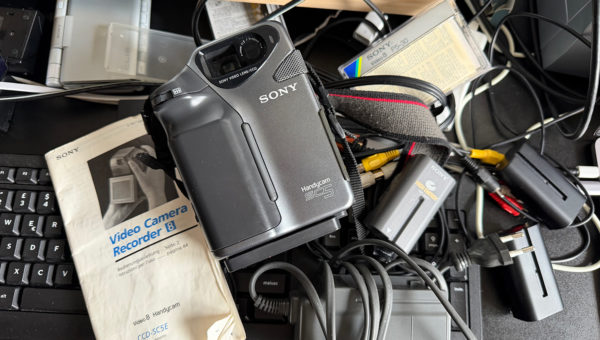
The Sony CCD-FX270 is a late-1990s Video8 Handycam — not Hi8, not MiniDV. It records on standard 8mm cassettes using the original Video8 format, which caps horizontal resolution at roughly 240 lines. That distinction matters because Sony was simultaneously selling Hi8 models (the CCD-TRV series) that recorded at 400 lines on the same tape size. The FX270 is the consumer-grade Video8 endpoint of the FX/FXE line, aimed at buyers who wanted a flip-out LCD screen and a long zoom range without stepping up to Hi8 pricing.
The FX270’s defining physical feature is its large flip-out LCD screen paired with a 20x optical zoom lens — a combination that was genuinely useful in the late 1990s when most camcorders still relied on small black-and-white electronic viewfinders. Sony marketed this model primarily in European and Asian markets under the FXE designation, with NTSC versions sold in North America as the FX270.
Historical Context
By the late 1990s, Sony’s Handycam lineup had bifurcated sharply. The CCD-TRV series carried Hi8 recording capability and NightShot infrared, occupying the mid-to-premium consumer tier. The FX/FXE series sat below that: still Video8 format, but equipped with flip-out LCD screens that the earlier TR-series cameras lacked. The FX270 arrived as Hi8 was already the industry standard and MiniDV was beginning its push into the consumer market with the DCR-PC1 and PC7 palmcorders. Sony was selling the FX270 to buyers who wanted a recognizable Handycam form factor with modern conveniences — particularly the swivel LCD — without the cost premium of Hi8 or DV.
The FX270’s closest contemporary competition was its own sibling: the CCD-TRV41 and TRV51 in Sony’s lineup recorded Hi8 at similar price points. Canon’s UC-series and Panasonic’s PV-series camcorders also competed in the Video8/compact market at this time, though most were moving toward Hi8 as well. The FX270 was, by the time of its sale, a format-limited option in a market already tilting digital.
Key Specifications
- Recording Format: Video8 (8mm tape, SP and LP modes)
- Image Sensor: 1/4-inch CCD
- Optical Zoom: 20x power zoom
- Digital Zoom: 200x (interpolated, not optically useful beyond 20x)
- LCD Screen: Color flip-out LCD (swivel design)
- Battery System: Sony InfoLithium NP-F series (NP-F330 / NP-F550 compatible)
- Video Output: Analog composite and S-Video
- Audio: Built-in stereo microphone, PCM audio on tape
- Recording Time: Approximately 90 minutes SP / 180 minutes LP on a standard T-160 tape
- Weight: Approximately 730g without battery; approximately 800g with NP-F330 battery
Hands-On Performance
The 20x optical zoom is the headline spec, and it delivers in bright conditions. At the wide end, the FX270 captures a usable field of view for interiors or group scenes. At full 20x telephoto, subjects lock in at a distance — useful for outdoor events — but optical stabilization is absent on this model, so handheld telephoto shots require a steady hand or a monopod. Sony’s SteadyShot electronic stabilization was not included in the FX270; that feature appeared on higher-tier TRV and PC models at the time.
The 1/4-inch CCD is the fundamental constraint. In good daylight the FX270 records clean Video8 footage with accurate color, but in interior lighting — a birthday party in a living room, a school play under fluorescent tubes — the sensor struggles. Noise becomes visible below roughly 200 lux, and below 50 lux the image degrades significantly. This was not a NightShot camera. Users who needed usable low-light performance would have needed to step up to the CCD-TRV67 or TRV68.
The InfoLithium battery system was a genuine advantage at the time. Unlike the Ni-Cd packs on earlier Handycam models, InfoLithium reported remaining charge time to the minute on the LCD display. An NP-F550 battery provides approximately 100–120 minutes of recording time with the LCD in use. The NP-F330 (smaller, thinner) cuts that to roughly 60–70 minutes.
Tape handling is standard Video8: the cassette door on the right side accepts T-60, T-90, and T-120 cassettes. SP mode gives 60–120 minutes depending on tape length; LP doubles that at some quality cost. The heads are susceptible to the standard Video8 failure mode: dried lubricant and worn pinch rollers after decades of storage. Most FX270s found today will need a head clean or full service before reliable playback.
Video8 Format Notes
The CCD-FX270 records in Video8, not Hi8. This is worth stating plainly because the cameras look similar and share tape size, but the formats are not equivalent. Video8 records a 240-line luminance signal on the 8mm tape at standard Video8 track pitch. Hi8 uses a higher track density and records approximately 400 lines of luminance using the improved Hi8 formulation tape. The FX270 will play back Hi8 tapes but cannot record in Hi8 format — the heads and servo system are Video8-spec only. If you record on this camera, the output is 240-line Video8 regardless of what tape formulation you load.
For archival purposes this matters. Video8 footage digitized from an FX270 captures roughly 240 effective lines of resolution. That transfers cleanly to standard-definition digital at SD resolution but gains nothing from Hi8 or Digital8 digitization workflows that expect 400-line source material.
Where the FX270 Fits in the FX Lineup
The FX series ran through several generations in the 1990s. The CCD-FX230 was a 10x-zoom Video8 model without a flip-out LCD. The FX270 stepped up to 20x zoom and added the swivel LCD screen. The CCD-FX420 and FX510 were later Video8 models with 10x zoom but refined designs. The FX620 was a later Hi8-capable model in a similar form factor. The FX270 sits at the mid-point of this line: it has the zoom and the LCD, but it never gained Hi8 recording capability before Sony moved this price point toward Digital8 and MiniDV.
Verdict
The CCD-FX270 is a competent Video8 camcorder that was already slightly behind the format curve at launch. Its 20x zoom and InfoLithium battery are genuine assets. Its 1/4-inch Video8 sensor and lack of image stabilization are real limitations that Sony’s own Hi8 TRV-series cameras addressed at comparable prices. For anyone digitizing family Video8 tapes recorded on this camera, it remains the best playback deck for those specific tapes. For fresh recording, it offers a recognizable Handycam experience with the format constraints of 1990s Video8. That tradeoff defined the FX270’s market position then and defines its collector interest now.